
How To Run Owlbears Like Terrifying Apex Predators In DnD
Tired of your owlbears feeling like big bags of hit points? Learn how to run owlbears as brutal, territorial monstrosities with real teeth. This guide from Monster Mechanics breaks down behavior, tactics, terrain, and roleplay so your next owlbear encounter feels dangerous, memorable, and cinematic at the table.
DUNGEONS AND DRAGONS
7/17/20249 min read
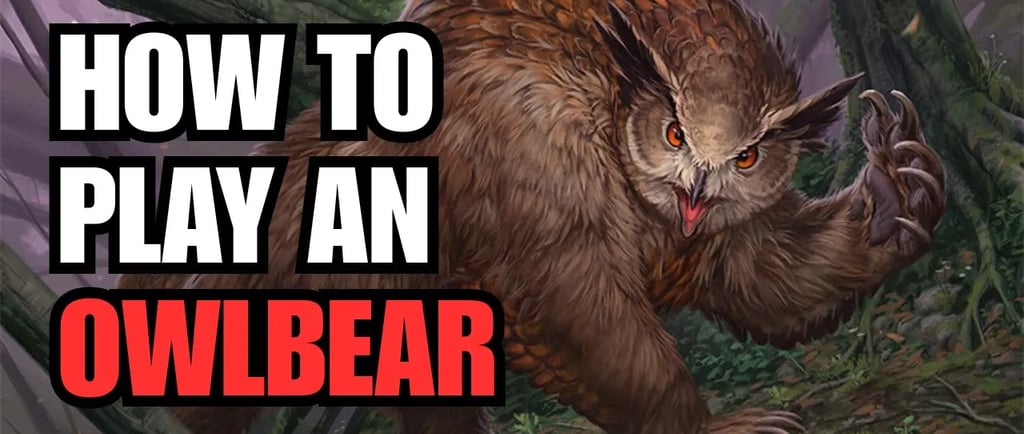
Ever feel like your owlbears are just… big angry chickens with hit points?
You drop this legendary D&D monster on the table, the players laugh, the wizard kites it, the rogue turns it into a pincushion, and by round three your “terrifying predator” is face down in the moss like last week’s random encounter.
Let’s fix that.
In this post we are going to take a basic owlbear breakdown and grow it into a full guide on how to actually run an owlbear so it feels like a brutal, panicked, unstoppable freight train of claws and beak. We are talking tactics, behavior, encounter design, and how to make it hit different on the battlemap.
And hey, while you are here, if you like this sort of breakdown, make sure you leave a comment, share it with a DM friend, and keep up with Monster Mechanics. It really does help keep this nonsense going.
What an Owlbear Actually Is
First thing to lock in: an owlbear is not a forest animal. It is a monstrosity.
That means it is not part of some gentle woodland ecosystem. This is an unnatural predator built for violence. Think “apex killing machine with glitches” instead of “big fluffy guardian of the woods.”
Rules wise, the classic D&D owlbear brings a few key numbers to the table.
It has a Strength of 20. That is “flip a cart, break a door, and pick up a fully armored fighter like a chew toy” territory. When this thing hits you, the party should feel the weight.
It has a Constitution of 17. So it does not just hit hard, it soaks punishment. The players will not chip this down with one or two lucky hits unless they get very organized.
Its Intelligence is 3. This is where a lot of DMs mess up. Low Intelligence does not mean “runs in circles doing nothing.” It means it thinks in instinct and pattern instead of plans and speeches. A shark is not smart in the wizard sense, but you do not want to be in the water with it.
Charisma is 7, which mostly just says “this thing communicates with roars and blood, not words.”
Perception is where it quietly shines. It has a solid passive Perception and advantage on Wisdom (Perception) checks based on sight or smell. Combined with darkvision in many versions, this means “sneaking past the owlbear” should feel genuinely risky. It is built to hunt you.
Then we get to the real star of the show: its attacks.
It has Multiattack, which lets it make one beak attack and one claw attack every time it takes the Attack action. The beak is nasty. The claws are worse, swinging with a high attack bonus and dealing 2d8 plus 5 slashing damage. That can drop a low level character to zero in a single hit and put serious fear in mid level folks if you roll well.
So: strong, tough, sharp senses, and hits like a truck. Simple on the surface, but there is a lot to squeeze out of this stat block if you run it like a real predator instead of a walking bag of XP.
How an Owlbear Thinks
Let us talk behavior, because that is where this monster really comes to life.
Intelligence 3 means your owlbear does not do tactics in the military sense. It does not flank consciously, call retreats, or come back with buddies who all multiclassed barbarian.
Instead it runs on instinct.
It attacks the most obvious threat in reach. That is usually the first creature that gets too close or the one making the loudest noise.
Once something hurts it in melee, its focus often snaps to that target. In the wild, whatever is in claw range and actively hurting you is the biggest danger, and the owlbear’s brain is wired to remove that danger with excessive prejudice.
It is not suicidal, but it also is not thinking about hit points. It will fight until it is badly wounded, until its lair or cubs are clearly threatened, or until something more terrifying shows up.
It is territorial. That means it attacks not because it is “evil” but because in its brain you have wandered into its hunting ground and you are messing up its food supply or threatening its nest.
So when you roleplay an owlbear, lean into pure emotion. Rage, fear, confusion, hunger, that kind of thing. It roars at sudden light, snaps at the bright spells, smashes toward sound and motion. No strategy meetings. Just explosive reactions.
A Forest Encounter: Breaking It Down
Let us build an example encounter you can drop straight into your game.
Picture this. The party is traveling through a dense, older forest. Not pretty Disney woods. Tall trunks, heavy underbrush, uneven ground. Visibility is maybe sixty to eighty feet if you are lucky.
Your owlbear notices them first.
Thanks to its excellent Perception and advantage on checks using sight and smell, it picks up the party by scent and sound before the wizard even finishes complaining about marching order. Maybe it smells the horse, the cooking grease on the fighter’s armor, the faint metal and ozone around the artificer. However you frame it, the monster knows something big and edible is moving in its territory.
On the battlemap, set this up by placing the party in a loose marching line, then putting the owlbear about eighty feet away behind some trees. Do not drop it in a perfect open lane. Give it a few trunks to weave around and some brush that gives partial cover here and there.
Because the owlbear is crashing through the trees, everyone hears it. Leaves shake, branches snap, there is that deep predator roar and the heavy thudding of paws and claws hitting earth. This is loud enough that there is no surprise round. Your players should feel the tension of knowing something is coming, watching the minis on the table as you move that beast closer.
Round one, it dashes.
It spots the group and barrels in its direction, closing the distance as fast as it can. With its speed, it eats a big chunk of that gap. It is not taking the Attack action yet, it is just closing and roaring, making itself a wall of noise and fur and feathers.
On the battlemap, show that. Move it far, shove minis aside slightly to show its path. Describe how trees splinter, how it shoulder checks a sapling out of the way rather than going clean around it.
Round two, it hits like a truck.
Now it is in range. The owlbear uses its Multiattack and goes for the first adventurer stupid enough or brave enough to still be up front. One beak, one claw. Roll openly, so they see the numbers. When it connects with those claws and you roll those 2d8 plus 5, read the total damage out slowly. Let it land.
Here is how you can narrate that on the map.
You move the owlbear mini right up into base contact with your front line character. You tilt its base slightly so it looks like it is mid lunge. Then you describe the impact: “It slams into you, hooks its beak into your shoulder, and then rakes down with a claw that tears through armor like old cloth. You feel ribs crack.”
The players now understand that this fight is not a casual warmup. That is what we want.
Target Selection: Who It Attacks and Why
One of the simplest ways to make an owlbear feel more real is to be consistent with how it chooses targets.
At the start of the fight, it attacks the closest thing in front of it. That is usually whoever was scouting or whoever panicked and ran toward it first. This is not smart. It is just “thing in front of me, smash” logic.
After that first round, you adjust.
If a melee attacker hits it for real damage, especially with something loud like a smite or a big axe crit, the owlbear turns on them. In its animal brain, that is the nearest serious threat. It does not care that the wizard is technically doing more damage from forty feet back. It cares about the paladin that just stabbed it in the chest.
If no one in melee is hurting it, it keeps tearing up the original target until that target drops or escapes. Once something stops moving, the owlbear may keep mauling for a round or two in a frenzy before it notices new threats.
If a ranged attacker hurts it critically from very close range, like a rogue with a crossbow at ten feet, you can justify it snapping sideways to rip that sneaky jerk in half. But if the archer is way in the back, it will usually roar and swat at the nearest thing instead because that is what its instincts tell it to do.
On the battlemap, you can make this clear by physically pivoting the owlbear mini to face whoever it is focused on. That small rotation tells the table “this is its target now.” When it drops someone, leave the monster standing over them, almost pinning that mini in place, to show it is still in that wild killing state.
How to Use the Terrain
Owlbears are not tactical geniuses, but they are still wild predators that know their own territory.
If you want to make a fight memorable, do not just throw it into a twenty by twenty flat clearing.
Give it trees, slopes, and obstacles. Maybe there is a fallen log it can leap over while the medium armored characters have to go around. Maybe there is a stream cutting across the map that slows some characters but not others. Maybe its nest is at the top of a low rocky rise full of uneven ground.
On your battlemap you can do a few simple things.
Drop a big fallen tree as a piece of terrain running diagonally. Put dense brush on one side that counts as difficult terrain. Place a couple of boulders or thick tree trunks that block line of sight. Let the owlbear charge around those and crash through tight spaces while the casters have to reposition for clear spell lanes.
It is not deliberately drawing people into traps. It is just using the paths it knows, and those paths naturally favor a heavy, fast, four legged beast over a party of bipeds in mixed armor.
Making It Hard To Sneak Past
Remember that perception bonus and advantage using sight or smell.
If the party insists on sneaking through its territory, lean into that.
Maybe as they move, you announce that there is a sour animal musk on the air. Claw marks at shoulder height on a tree. Half eaten carcass of a deer ripped open in a brutal way. Those are warnings.
If they still push forward, have everyone roll Stealth like normal, but roll the owlbear’s Perception with advantage and do it behind the screen. Even if some of the party beat its passive Perception, a few members probably will not, and the monster only needs one weak link.
On the map, you can show their path first, then drop the owlbear mini, nose to the ground, tracing their scent and intersecting them from an angle instead of head on. That makes it feel like it was actively hunting, not just standing around waiting for an initiative roll.
Roleplaying the Roars and Body Language
It may not talk, but you can absolutely roleplay an owlbear.
Give it sounds. Deep hoots that slide into roars. Short, sharp screeches when it gets hurt. Low warning growls when someone gets close to its nest.
Give it body language. Feathers puffed up when it tries to intimidate. Head cocked sideways when bright light or strange magic confuses it. Defensive positioning over a nest, with its body between the party and a clutch of eggs or cubs.
If the party stumbles on its lair, you can put a nest on the battlemap in a corner of the clearing and place some small tokens for eggs or young. Have the owlbear physically move between those and the intruders. That one visual instantly explains the fight. It is not evil. It is desperate and furious.
How To Make It Scary Without Being a Jerk
You do not need to kill characters to make the owlbear memorable. You just need to make it feel like the stakes are real.
When it crits, describe bones snapping. When a character drops to zero, describe them getting ragdolled and flung into a tree, or pinned under a massive claw. The cleric can still get in there with a heal, but for a moment everyone at the table goes “oh no, that could have been me.”
If the owlbear gets badly injured, give it a moment of hesitation. A panicked roar. A quick look back toward its lair. Then you decide if it fights to the death, flees, or starts dragging an unconscious body away as food or leverage.
That last option is a fun one. Instead of finishing off a downed character, it grabs them and starts hauling them toward the treeline. On the map, you literally move that mini with the owlbear each round. Now the party has to decide whether to chase, heal, or cut their losses. Suddenly this is not just combat. It is a rescue scramble.
Turning Your Simple Stat Block Into a Story
So to wrap it up.
Owlbears are brutal fighters with high Strength and Constitution who use straightforward, aggressive tactics. They have strong perception and are difficult to sneak past. They attack the first target they see, then often switch focus to the melee attackers that are hurting them.
If you play those basic truths consistently, use the terrain, and lean into their instincts and body language, this very simple monster suddenly becomes one of the most memorable fights of the campaign.
You do not need to rewrite the stat block. You just need to run what is already there with intent.
Give it a loud entrance. Let it hit hard. Let it feel like a living creature trying to survive and protect its territory, not a puzzle to be solved with optimal DPR.
And when you do run an owlbear that way, I want to hear about it.
Drop your best owlbear story in the comments. Tell me who it dropped to zero, what got destroyed on the battlemap, and whether the party still talks about it three sessions later.
If this helped you think differently about a “basic” monster, share it around to your fellow dungeon masters and keep an eye on Monster Mechanics for more breakdowns like this.
Now go grab an owlbear, sketch a messy forest battlemap, and get ready.
Roll initiative.