
How To Run A Beholder In DnD 5e: Tactics, Anti-Magic Cone, And Eye Ray Guide
Turn your beholder into a true boss fight. Learn smart eye ray targeting, anti-magic cone tactics, and lair design tips to terrify your DnD 5e party.
DUNGEONS AND DRAGONS
7/22/20249 min read
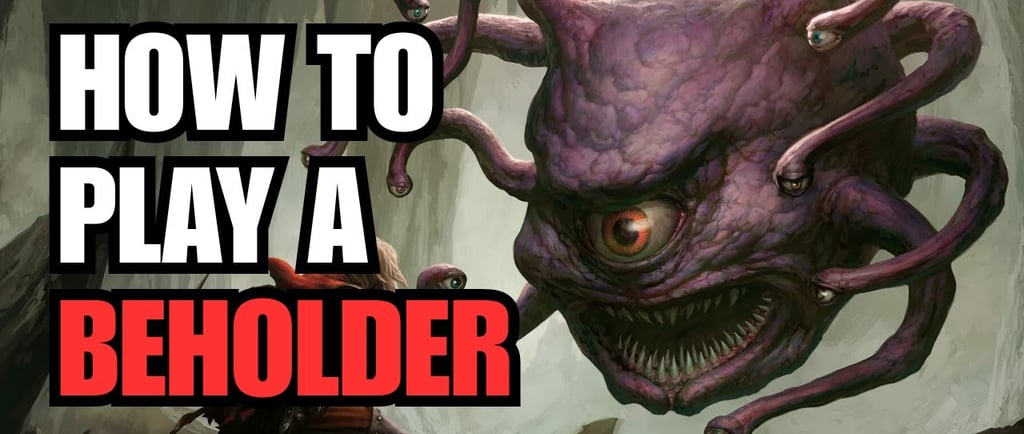
Have you ever dropped a beholder on the table and thought, “Wait, that’s it?”
Your party blasts through it, the anti magic cone feels awkward, and somehow this legendary eye tyrant turns into a floating stress ball with lasers instead of a terrifying mastermind.
Let’s fix that.
This post is going to walk through how to run a beholder using the exact mechanics from the script you shared. We will talk stats, eye rays, the anti magic cone, lair actions, legendary actions, and how to put it all together so your players walk away saying, “We almost died. That was awesome.”
What a beholder really is at the table
On the stat block side, the beholder is an aberration with high Dexterity, very high Constitution, and brutal mental stats. Around 180 hit points. Armor Class 18. It hovers, so knocking it prone is off the table. With absurd Perception and darkvision out to 120 feet, trying to sneak up on it in its own lair is usually a fantasy.
That tells you how to play it.
You are not running a big round hit point sponge that politely waits for initiative. You are running a paranoid floating genius that assumes everything is a threat, sees you coming well in advance, and has designed its lair around killing people like your party.
So the encounter should never feel like the party opens a door and just happens to surprise it. The beholder is already alert, already positioned in the air, and already thinking about who looks the most dangerous.
On your battlemap, place the beholder near the ceiling or hovering over a pit or chasm. Give it vertical distance and lines of sight instead of just dropping it on the ground in the middle of the room.
The eye rays are not random nonsense
Rules wise, a beholder fires three eye rays per turn, chosen at random. That part is important. You roll to see which rays you have available.
Here is where things go wrong at a lot of tables.
People roll the rays, then just fire them at whoever is closest or whoever annoyed the DM last round. That makes the monster feel like a chaotic laser sprinkler instead of a smart, focused killer.
Every ray uses a DC 16 save, but they do different things and target different abilities. The key is not memorizing every line. The key is matching each ray to a weakness.
Charm ray uses a Wisdom save. Aim this at a heavy hitter who is not great at Wisdom. A barbarian, fighter, or similar. If they fail, they are charmed and suddenly not punching your floating nightmare. They might even try to convince everyone else not to.
Paralyzing ray uses a Constitution save. Paralysis is brutal. A paralyzed character can be auto crit if hit from within 5 feet. The beholder itself likes to stay out of melee, but its minions and lair tentacles love a paralyzed target.
Fear ray uses a Wisdom save. This ray is perfect for forcing melee characters to back off. You can keep the paladin or rogue away from you, or drive someone into a worse position.
Slowing ray uses a Dexterity save. This is a nice way to punish high mobility characters. The monk who loves to dash across the map or the rogue who relies on repositioning suddenly feels very stuck.
Enervation ray uses a Constitution save and deals 8d8 necrotic damage. This is a huge hit. Aim it at someone who is already hurt or who you know has poor Constitution saves. It is a great ray for pushing someone toward unconsciousness.
Telekinetic ray uses a Strength save and lets you push a creature up to 30 feet. This is one of the most fun rays on the map. Push someone off a ledge, out of cover, into the anti magic cone, or straight into a patch of slime. The ray does not do damage, but the battlefield can.
Sleep ray uses a Wisdom save and drops the target unconscious. Use this on casters or key support characters. The best part is that they are not dead, so the party will waste turns waking them or protecting them.
Petrification ray uses a Dexterity save and starts turning the target to stone. This is a built in tension machine. One failed save now, another later, and suddenly you have a player character statue. That timer changes how everyone plays.
Disintegration ray uses a Dexterity save and deals 10d8 force damage. Beyond melting hit points, it can also destroy cover and pieces of the environment. Use this to remove bridges, pillars, barricades, or whatever clever hiding spots the party thought they had.
Death ray uses a Dexterity save and deals 10d10 necrotic damage. This is your finisher. If someone is low on hit points, the beholder absolutely points this at them and tries to erase them from existence.
Here is the mindset shift.
You still roll randomly to see which rays you get each turn. That part is non negotiable. But once you know which three rays are available, you choose targets very carefully. Each round, look across the table and ask three questions.
Who is worst at the saves these rays use.
Who is currently the biggest threat to the beholder.
Who can I push closer to death, panic, or being removed from the fight entirely.
Pick targets based on those answers. Suddenly the beholder feels like a cruel tactician instead of a random effects machine.
The anti magic cone is battlefield control, not a passive aura
The central eye projects an anti magic cone out to 150 feet. Inside that area, spells and magical effects are suppressed. Spellcasting is crippled, magic items go quiet, summoned creatures vanish, and all those buffs and auras suddenly flicker out.
Common mistakes look like this.
Leaving the cone pointed straight at the party the entire fight and then forgetting that it also shuts off the beholder’s own eye rays.
Pointing it somewhere once, then never adjusting it as the battle moves.
Treating it like a cool flavor detail instead of one of the most oppressive tools in the game.
Instead, treat the cone like a giant invisible spotlight of “no magic allowed” that the beholder sweeps around intentionally.
On your battlemap, actually draw the cone or mark it with a clear template. Use a wedge of paper, a transparent overlay, or a dry erase line showing its edges. Let your players see exactly where the border is so they can feel the pressure of crossing in and out.
If the party hangs back and plays at range, start the fight with the cone aimed right at the casters and ranged attackers. Their spells fail, their magic arrows lose their bite, and their shiny items fizzle. The message is simple. Get out of that cone or do nothing.
If the party closes in, rotate the cone to catch as many spellcasters and magic gear users as possible while leaving your own eye rays to work on targets outside the cone.
The beholder does not need to spend its whole turn moving the cone. It just rotates its body and the cone moves with it. That means during your turn you can do something like this.
Start with the cone aimed at the wizard and cleric. Fire your eye rays at the barbarian, who is outside the cone. At the end of the turn, pivot the cone to get the sorcerer and warlock instead, forcing them to reposition on their turns.
You want your players to feel like the anti magic cone is chasing them. Not static. Not forgotten. Actively hunting down whoever relies on magic the most.
Legendary actions keep the pressure constant
The beholder has legendary actions that let it act outside its normal turn. Usually that means firing additional eye rays or doing other nasty tricks.
The single biggest upgrade you can make is this.
Use legendary actions often. Do not forget them.
At the end of each player’s turn, look at your pool of legendary actions and ask, “Do I want to punish that move” or “Is now a good time to add pressure.”
If the rogue ducks out from behind cover, takes a shot, then dives back, hit them with a ray before they hide again.
If someone heals a near death ally, use a legendary eye ray to threaten that same ally again. Show the party that the beholder notices who they protect.
If a character is trying to run away with a downed friend, slap them with telekinesis or fear to interfere with the retreat.
Legendary actions are how you make the beholder feel active on everyone’s turn, not just its own. The fight stops feeling like turn based trading and starts feeling like the monster is always looming over them.
Lair actions turn the room into a second enemy
Inside its lair, the beholder has environmental tricks on initiative count 20. These are not just extra attacks. They are how you make the battlefield itself dangerous.
Some examples from the script.
Slippery slime. The floor gets coated in slimy goo that turns sections into difficult terrain or forces checks to keep your footing. This is perfect for narrow bridges, ledges, and ramps.
Grasping appendages. Tentacles sprout from the walls and ceilings, grabbing at characters, restraining them, or pulling them toward edges, pits, or other hazards.
Eye of the Beholder. An extra random eye ray effect, basically turning the whole lair into an extension of the beholder’s central paranoia.
On your battlemap, show these things clearly.
Draw patches of glistening slime on the stones. Color certain sections a different shade and tell players that area is slick and treacherous.
Mark spots on the walls where tentacles might erupt. When a lair action happens, drop a token or marker there and describe it.
“The wall behind you pulses like a living thing. A purple tentacle bursts out and snaps around your leg, dragging you toward the edge of the pit.”
Suddenly it is not just a beholder floating in a cave. It is a lethal environment with moving parts, shifting ground, and unexpected grabs. The players will start using the terrain too, which makes everything feel more dynamic.
A sample encounter you can steal
Let’s put this into a simple scenario you can run.
Picture a wide cavern with a deep central pit. Thin stone bridges crisscross above it at different heights. The walls are studded with rocky outcrops and strange organic nodules that hint at lair activity.
The beholder hovers thirty feet above the center of the pit, waiting. It has already heard the party coming with its massive Perception and has had plenty of time to plan.
As the party enters, the beholder is already watching the tunnel. It angles its anti magic cone directly down that passage so that the moment the wizard, cleric, or warlock steps out, their spells die in their throats and their magic gear goes quiet. On the map, you lay the cone template right over that entrance area so everyone sees it.
Round one, initiative.
The beholder acts early. It rolls three eye rays. Maybe it gets charm, sleep, and disintegration.
It charms the barbarian charging across the bridge so they pause, confused, suddenly unsure if this floating eye monster is really the problem.
It hits the support caster with sleep, dropping them on the stone before they really get going.
It uses the disintegration ray not on a character, but on one of the stone supports under a bridge. The rock explodes into dust and a chunk of the bridge collapses, forcing a Dexterity check or sending a character tumbling toward the pit.
Then, on initiative count 20, the lair oozes slime over the middle of the main bridge, turning it into a slick mess that every melee character feels forced to cross.
Legendary actions pepper the round. When the rogue peeks out to line up a shot, a fear ray hits them and sends them scrambling back.
Round two.
The party adapts. Some try to rush out of the cone to get their magic online. Others stay in and try to muscle through with weapons. The beholder rotates the cone to keep the maximum number of spellcasters inside it each round. It focuses its eye rays on the few targets who manage to stand outside the cone, hunting for low Dexterity or low Wisdom saves.
Tentacles erupt from the walls and grab the healer, dragging them toward the pit edge, setting up a telekinetic shove later. The rogue, now only partly petrified from a previous hit, feels that ticking clock and must decide between helping allies or trying to save themself.
The fight goes on like this. Not a static slugfest, but a constant puzzle of movement, repositioning, and hard choices. The beholder is never just sitting there. It is adjusting its cone, picking targets for rays with intent, and using lair and legendary actions to keep momentum.
By the time they kill it, the party should feel like they solved a deadly dungeon boss, not just burned down a big bag of hit points.
The three habits that change everything
If you want your beholder to feel like a true event instead of a floating monster, keep these three habits in mind.
Use eye rays to target weaknesses, not just whoever is closest. Think about saves, roles, and who hurts the beholder the most.
Aim and move the anti magic cone on purpose. Rotate it to chase casters and shut down magic gear. Make stepping in and out of the cone an important decision.
Lean on lair actions and legendary actions. Do not leave them on the sheet. Use them to keep the pressure steady between turns so the beholder always feels present.
If you do that, your players will remember the night they fought the beholder. Not just because of how much damage it did, but because the encounter felt alive, tricky, and personal.
If you enjoy this kind of monster breakdown and you want more help turning classic creatures into unforgettable encounters, keep an eye out for more from Monster Mechanics. And hey, share your wildest beholder stories with your group, steal what works, and make it your own.
Now go make your table fear the floating eyeball again.