
How Smart Monsters Really Fight: Using Instinct, Intelligence, and Alignment in D&D
Want your D&D 5e monsters to feel smarter and more dangerous? Learn how to use Intelligence, Wisdom, alignment, and action economy to guide monster tactics, survival instincts, and target choices. Make goblins, dragons, and every creature in between fight like they actually want to live.
METAGAMINGDUNGEONS AND DRAGONS
7/8/20248 min read
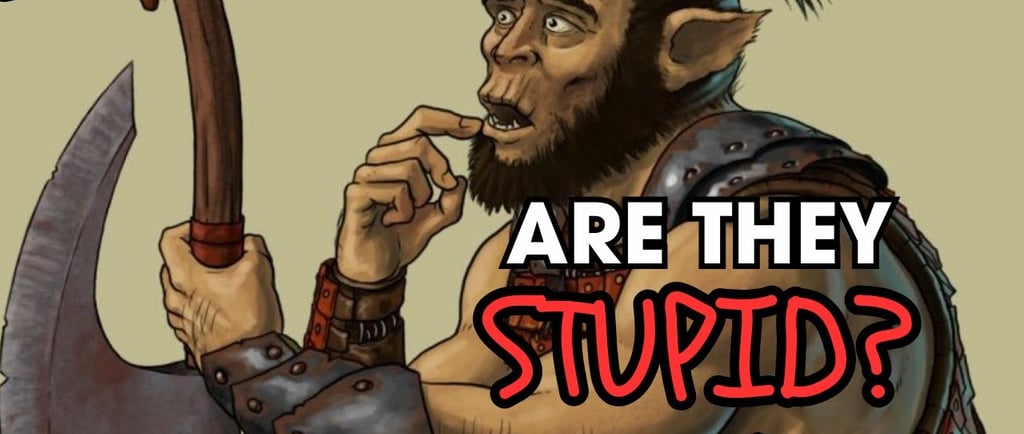
How Smart Monsters Really Fight: Using Instinct, Intelligence, and Alignment in Your D&D Encounters
Ever had a goblin run away “too early” and your players went, “Wait… can they do that?”
Or watched a dragon casually delete your wizard on round one and thought, “Did I just make that up, or is that actually what this thing would do?”
Here’s the thing: monsters aren’t just bags of hit points and damage dice. They have instincts. They have priorities. They absolutely have opinions about whether they want to die for this cause today.
If you lean into that, your combats stop feeling like “numbers trading blows” and start feeling like real creatures fighting for their lives, goals, or territory.
So let’s take the ideas from that video transcript and turn them into a clean, usable framework you can bring straight to the table.
Step One: Monsters Want To Live (Usually)
Start with this assumption: most creatures don’t want to die for no reason.
A simple rule of thumb you can use behind the screen is this:
When a creature drops to around 40% of its hit points or less, it starts seriously thinking about escape.
That doesn’t mean it always runs. It means you, as the DM, check in with yourself:
Is this creature the type to bail and run?
Is it defending something it values more than its life?
Is it too dumb or too proud to notice how badly it’s losing?
Does it think fleeing is even possible?
You’ve got two big categories of “they don’t run”:
Fanatics. Cultists, zealots, sworn knights, undead bound by magical command. These are your “fight to the last breath or hit point” types. If the story says they’re willing to die for this, lean into it.
Creatures that know they can’t escape. A slow, lumbering ogre fighting a party with multiple ranged attackers might instinctively realize, “If I turn my back, I’m dead.” So it digs in and keeps swinging.
For everyone else, survival is on the table once they’re hurt badly enough. They might:
Break and run.
Drop their weapons and surrender.
Try to bargain.
Disengage and retreat to a defensible position.
Or even call for reinforcements while falling back.
That one little 40% “check-in” flips so many combats from flat to interesting.
Intelligence: How Much Can This Thing Actually Think?
The Intelligence score tells you how much a creature can analyze and adapt.
Here’s a simple way to read those numbers when you look at a stat block.
If Intelligence is 7 or lower, this creature runs on instinct.
It has a basic attack pattern that “worked in the past,” and it runs that script on loop.
The wolf charges the weakest-looking target and bites.
The zombie shambles toward the nearest living thing and swings.
The ochre jelly oozes toward the closest warm body and engulfs it.
Even if the situation changes, they don’t really learn inside the fight. They just keep doing what they do.
If Intelligence is 8–11, they can notice when things are going badly and adjust a little.
A bandit with average intelligence might swap targets if one PC looks badly injured. A basic beast might realize “fire hurts more” and shy away from the character with the torch.
They’re not masterminds, but they’re not completely clueless either. They recognize patterns like “wizard in dress = danger fire person.”
At 12 or higher, they can plan and coordinate.
These creatures are capable of simple tactics:
Flanking with allies.
Prioritizing the healer or the glass cannon.
Holding actions to trigger at a smart moment.
Switching from “kill” to “take hostage” when the tide turns.
They can come into a fight with a plan and adjust it on the fly.
At 14 or higher, you’re dealing with tactical brains.
These are your dragons, warlords, masterminds, devils, archmages.
They:
Identify weak points in the party’s defenses.
Use terrain, lighting, and chokepoints deliberately.
Remember what spells or abilities the party used earlier and counter them in future encounters.
Retreat not as a panic move, but as a tactical reset.
If this thing has 14+ Intelligence, ask yourself, “How would I fight if I were trying to win this battle and I had this body and this lair?” Run it like a chess player, not a drunk brawler.
Wisdom: When Do They Run, Who Do They Hit?
If Intelligence is “how smart am I?”, Wisdom is “how good is my instinct?”
Wisdom affects three big things:
When they decide it’s time to flee.
Who they choose as targets.
Whether they recognize danger before it hits them in the face.
With low Wisdom, a creature may wait too long to run.
The ogre with low Wisdom just keeps swinging because it doesn’t feel like it’s losing until it’s too late. The giant spider ignores the obvious fact that the fighter is baiting it into a flanking trap.
At Wisdom 8–11, they have decent survival instinct.
They generally know when things are going bad and it’s time to consider escape or surrender. They’re not picky with targets, though—they’ll usually just attack whoever is nearest or whoever just hurt them most.
At 12 or higher, they’re choosing targets thoughtfully.
They’ll go for:
The healer keeping everyone standing.
The wizard who keeps dropping fireballs.
The rogue who is clearly tearing them apart from the shadows.
They’re also more likely to choose flight, surrender, or even negotiation if the fight looks unwinnable.
A high-Wisdom creature might say, “You’ve proven yourselves. Take what you came for and leave my lair, and we’ll call it even,” instead of fighting to the last hit point. That choice alone can make your world feel so much more alive.
Physical Abilities: How Does This Thing Fight?
Now layer in Strength, Dexterity, and Constitution.
These three scores tell you what fighting style the creature is built for.
A creature with low Strength often compensates with numbers.
If it can’t hit hard, it brings friends. Think goblins, kobolds, swarms of tiny creatures. They lean on pack tactics, flanking, and overwhelming the party with actions rather than raw damage.
A creature with low Constitution prefers not to get hit at all.
Squishy creatures gravitate toward:
Ambushes from hiding.
Hit-and-run attacks.
Staying at range rather than mixing it up in melee.
They know—consciously or instinctively—that a couple of solid hits will end them.
A creature with low Dexterity usually needs armor or big, scary buddies.
If it’s slow and clumsy, it’s either:
Wearing a lot of armor.
Naturally heavily armored (thick hide, stone skin, chitin).
Or relying on other creatures that can cover for its slow reactions.
Put that into English for your table:
High Strength + high Constitution? This thing loves a straight-up brawl.
It wades into the thick of melee, shrugs off hits, and just keeps swinging. Ogres, giants, some demons—that type.
High Strength + low Constitution + high Dexterity?
Think stealthy, high-damage stalkers. They hit hard but can’t stay under focus fire for long. They favor ambush, assassination, and getting out before the retaliation hits.
Low Strength + high Dexterity + high Constitution?
These are scrappy, nimble survivors. They dart in, stab, duck away. They rely on positioning and agility, but they can also soak a surprising amount of punishment for their size.
When you glance at a stat block, read those three scores as “how does this thing want to fight, if it has any say in the matter?”
Action Economy: Monsters Want the Best Trade Every Round
Let’s talk action economy for a second, because this is where smart monster play really shines.
Every creature in 5e gets the same basic kit each round:
One action.
Possibly one bonus action.
Movement.
One reaction between their turns.
Your monsters want to use these in the most efficient way they’re capable of, based on their Intelligence and Wisdom.
Creatures will favor anything that:
Grants them advantage.
Imposes disadvantage on the PCs.
Forces saving throws on multiple characters at once.
Controls positioning (grapples, shoves, knockdowns, forced movement).
If an ability gives them a better trade than “I swing my sword once,” they’ll use it whenever they understand how good it is.
A simple example:
A smart brute that can shove and then attack will:
Shove the fighter prone.
Then attack with advantage.
And stay in melee so anyone trying to stand provokes attacks or loses actions.
A spellcasting monster with decent Intelligence will:
Open with its best area-control spell.
Use its bonus action for defensive buffs or movement.
Keep its reaction for shield or counterspell if it has them.
A low-Int beast with a powerful grapple will:
Grab and drag prey away rather than standing still and trading hits. That’s not tactics so much as animal instinct: “I want to eat this thing somewhere safer.”
When in doubt, look at your monster’s features and ask, “If this thing had used these in fights before and seen them work, what would it naturally default to?”
Alignment and Attitude: Are They Even Hostile?
We also need to talk about something a lot of tables forget: alignment and attitude.
Alignment is not a script, but it does tell you how creatures feel about strangers walking into their space.
Good-aligned creatures are generally friendly or at least approachable.
They might be cautious, but they’ll usually talk before attacking unless there’s a really clear reason not to.
Neutral creatures are often indifferent.
If you don’t mess with them, they might not mess with you. Territorial neutrals might warn first, attack second.
Evil creatures tend to be hostile.
They’re more likely to see the party as prey, tools, or threats to be eliminated.
But then you layer Lawful, Neutral, and Chaotic on top.
Lawful creatures care about rules, oaths, and territory.
A lawful good guard might still arrest or attack the party if they’re breaking sacred laws or trespassing. Not because they’re evil, but because enforcing order is part of their nature.
Chaotic creatures are wild cards.
They might help you one moment and stab you the next. They’re less predictable, and that’s fun to lean into.
Before you roll initiative, ask:
Does this creature really want a fight?
Is it defending something?
Is it hungry? Afraid? Following orders?
Would it warn first? Demand payment? Challenge to a duel?
Not every monster encounter has to start with “roll initiative.” And the ones that do can still be flavored by what the creature thinks of the party’s presence.
Putting It All Together at the Table
So when you prep or run a monster, try this quick mental checklist:
How badly does it want to live?
At around 40% HP, will it run, surrender, bargain, or dig in and fight to the death?
What does its Intelligence say about how it fights?
Is it mindless and instinct-driven, average and reactive, or tactical and planning?
What does its Wisdom say about survival and target selection?
Does it pick targets at random, hit whoever’s closest, or deliberately go after the healer/mage?
What do its physical stats say about its style?
Is it a tank, a skirmisher, an ambusher, or a glass cannon?
How does it use its action economy?
Does it understand advantage, positioning, and its own special abilities?
And finally: what does its alignment and attitude say about whether it wants this fight at all?
You don’t have to write all this down every time. Just glance at the stat block, run through those questions in your head, and let the answers shape your choices round by round.
Suddenly, your goblins stop feeling like “CR 1/4 speedbumps” and start feeling like terrified little survivalists. Your dragons stop feeling like bags of hit points and start feeling like apex predators with a plan.
If you dig this kind of “monsters as thinking creatures, not just stat blocks,” keep an eye on Monster Mechanics. This is the stuff I love breaking down—how to run smarter monsters, build better encounters, and make fights feel dangerous without making them miserable.
Now go take a look at a monster you plan to use this week, run it through this lens, and see how it changes the way you picture that combat.
Then roll initiative and let the adventures begin.